
Kato Steven Mubiru (Crane AI Labs) and Idah Pswarayi-Riddihough (Flame Lilly Global) · November 2026
This is a design, offered for criticism. It proposes one experiment, in one city, to answer a question the field currently guesses at: what it costs to move an informal-economy worker from first access to sustained, independent use of an AI tool; whether a trusted human intermediary is a transitional cost of that or a permanent one; and whether anyone other than a donor will pay for it. If you know of work that already answers these questions, we would rather be told than repeat it.
1. The question
A set of things that were open questions two years ago are now settled. Small open-weight models run offline on entry-level Android phones. They can be adapted to African languages. Low-literacy users will speak to them rather than type. On-device inference also collapses the marginal cloud-compute cost of an interaction toward zero.
What remains unknown is the thing that determines whether any of it produces value: what does it actually take, operationally and financially, to move an informal-economy worker from first access to sustained, independent use of an AI tool? And what does that cost per person?
The marginal cost of an interaction is not the cost of adoption. Adoption carries device access, onboarding, human support, language maintenance, telemetry, compliance and retention effort. That full cost is not established, and it is what the experiment described here is designed to measure.
A note on terms
Adoption terms are used here in the sense established in the implementation and diffusion literature: Rogers' innovation-decision sequence, RE-AIM's separation of reach, effectiveness, adoption, implementation and maintenance, and Proctor and colleagues' distinction between penetration and sustainability. Each is defined once, in section 3, and used consistently thereafter. The field currently uses "adoption", "engagement" and "independent use" interchangeably. A cost per adopter is only interpretable if the denominator is defined precisely and identically across every arm of a study.
What already exists, and why this is not it
We have not identified a published study that isolates the incremental cost of moving this population from onboarding to sustained independent use while experimentally testing the contribution of a trusted human intermediary. Two bodies of work come closest, and we distinguish ourselves from both rather than leave a reader to raise them.
Otis, Clarke, Delecourt, Holtz and Koning randomised access to a GPT-4 business assistant among 640 Kenyan entrepreneurs, could not reject a null average effect on revenues and profits, and found markedly worse outcomes for those low-performing at baseline than for high performers. That is consistent with our own hypothesis that unmediated access is not adoption, and that the users who most need help are least able to filter what they receive. The study prices access, at a few dollars per participant. It does not price sustained independent use, and it did not test an intermediary.
Digital Green's Farmer.Chat deploys through agricultural extension agents rather than direct to farmers, precisely to keep a human in the loop, and reports very large user numbers across several countries. There the intermediary layer is assumed rather than tested, and its cost per sustained user is not published.
Our contribution is to test that assumption and price it.
2. Starting conditions
The technology is not the hypothesis; it is the precondition. Stated qualitatively, because the point of this piece is what we do not yet know.
- Crane builds and deploys offline-first, voice-first AI in African languages on entry-level Android hardware, with the full loop, speech in, reasoning, speech out, running on-device without connectivity.
- Device-level performance thresholds are defined and tested against physical entry-level handsets rather than assumed, including memory ceilings low enough that the tool does not evict other applications, which is a practical determinant of whether real users keep it installed.
- Language capability is treated as a build task with its own quality bar, not as an assumption about general-purpose models.
- Crane authored the Uganda Cultural Context Benchmark, included in Inspect Evals, an open evaluation ecosystem developed with the UK AI Security Institute, Arcadia Impact and the Vector Institute. It reflects a working habit of measuring model quality against cultural context rather than asserting it.
- Field deployment experience with frontline workers in low-connectivity rural settings, including telemetry instrumented into the product rather than added afterwards.
What that experience taught us is narrower than it sounds. We have observed individual users adopt a tool spontaneously and use it independently in a real, high-stakes moment. But a single episode of independent use is not sustained adoption, and our definitions below insist on that distinction. We cannot yet say what produces it, what share of users reaches it, how long it takes, or what it costs. That gap is the subject of this piece.
3. The hypothesis
Adoption fails in an observable sequence, and each stage fails for a different reason. The stage names follow implementation-science convention rather than internal shorthand.
Definitions used throughout
- First use: the participant completes the defined livelihood task once, with or without help.
- Sustained use: at least one task-completing session per week for twelve consecutive weeks.
- Unassisted use: a task-completing session in which the participant received no human help of any kind: not from a programme facilitator, not from a family member, not from a neighbouring trader.
- Independent adoption, the primary outcome of the study: sustained use in which every session in the twelve-week window is unassisted.
- Routine use: independent adoption maintained to day 180.
These definitions are arm-neutral by construction. "Unassisted" refers to the absence of any human help, not of a programme facilitator. Defined as "no facilitator contact", independence would be trivially satisfied in an arm that has no facilitator, and a tool-only arm could win by construction. The measure means the same thing in every arm.
The hypothesis itself
Our hypothesis, drawn from field observation and stated as a hypothesis rather than a finding, is that the binding constraint is neither the model nor the device, but the trusted intermediary. Adoption occurs when someone the user already trusts introduces the tool inside an existing relationship.
What we do not assume is what happens next. The experiment is built to establish which of three things is true.
- A transitional cost: necessary to start adoption, dispensable once independent use is established. The role is financed once per cohort, then withdrawn, and the steady-state cost of adoption is low.
- A standing cost: a permanent part of what it takes to keep informal-economy users using an AI tool. The role belongs in the unit economics of every deployment, it must have an identified payer, and any programme budgeting for software alone is under-costed.
- A standing cost that is not a public one: the possibility we think most likely, sitting between the two. If the role can be carried by people who already earn commission for an adjacent service, it may sustain itself commercially with little or no subsidy. The design tests this directly, by tapering the stipend to zero in one arm while holding it constant in another.
All three are financeable findings and each changes what a funder or a ministry should do next. What is unhelpful is the present situation, in which the intermediary layer is neither tested nor priced, and a considerable amount of current programming assumes an answer.
4. The experiment
One city, one population, one channel, one language, one use case.
- Country: Zambia. It has a National AI Strategy led by the Ministry of Technology and Science, with a National AI Council and a defined role for the Smart Zambia Institute, which gives the work an institutional home. And it sits outside the countries where national AI scaling support is already concentrated, which matters methodologically: adoption effects are not confounded with hub-level support absent in a general deployment, so the estimate transfers rather than being an artefact of one place.
- Population: Traders at a major Lusaka market: a dense, informal population with measurable daily economic tasks, stock decisions, sales tracking, informal credit, price movement. The sample is stratified by commodity segment, because turnover cycle and record-keeping need differ sharply and a single-segment result would not transfer: fresh produce and perishables; dry goods and staples; non-food durables. Cost per independent adopter is reported by segment as well as in aggregate, so the range is visible rather than only its most favourable end. Traders organised into cooperatives or savings groups are not representative of the informal economy as a whole: they are likely to be more organised, more creditworthy and more literate than the average. The resulting estimate is a lower bound on cost and an upper bound on reachability, and the published result will say so.
- Channel: Existing traders' cooperatives, village banking groups or comparable trusted market institutions. Their secretaries or other trusted leads form one candidate facilitator group; mobile-money agents operating inside the market form a second. We are not creating a new cadre. The experiment tests whether AI adoption can travel on trust structures that already exist.
- Language: Nyanja, the widely used Lusaka lingua franca. Crane does not yet have a validated Nyanja model stack for this use case. Nyanja is not low-resource in the sense of lacking speakers or usable text, and the build is tractable; the risk is not that it cannot be built but that enrolment could begin before it is good enough. A pre-registered readiness gate, covering speech-recognition accuracy on recordings from the target population, task success scored by native-speaker raters, and a Zambian cultural-context evaluation, must be met before enrolment opens. If the gate is not met, enrolment is delayed rather than the threshold lowered. This is the difference between a null result that means "the intermediary does not matter" and one that means "the model was not ready", and the two are indistinguishable after the fact.
- Use case: One: a voice tool that helps a trader track sales, anticipate demand, and keep a record a lender could read. Not a general assistant.
- Devices: The experiment runs on handsets participants already own. Providing free devices would calibrate the cost estimate to a scenario no ministry will face, and would introduce both a resale risk and an incentive effect that inflates measured retention. A design that assumes devices are bought is not a design a government can use. This imposes a screening requirement, and we will report what share of the enumerated population it excludes. That exclusion rate is itself a finding: the first published measure of how much of an informal trading population an on-device tool can reach without buying hardware.
- Duration: Longer than we would like, and set by the measurement requirement. A language build, a twelve-week independent-use window, 180-day retention and any post-subsidy signal do not fit in eighteen months.

Design
Randomised at cluster level, with cooperatives, savings groups or comparable trusted bodies as clusters. Individual-level randomisation within a market would guarantee contamination.
Two contrasts do the work. A against B1 and B2 pooled isolates and prices the intermediary layer: if Arm A performs comparably, deployment can be far cheaper than currently assumed; if the supported arms substantially outperform it, the intermediary layer is a necessary component of the adoption model and its cost belongs in the unit economics of deployment. B1 against B2 tests whether the layer can be made to pay for itself.
The tapered agent strand, and why it is not optional
The most important question here is not what the intermediary layer costs. It is whether anyone other than a donor will pay for it. If a programme pays the stipend, "the facilitator earns income" partly measures the fact that the programme paid. A design that cannot get past that returns a price with no payer attached: a research finding rather than something a ministry can act on.
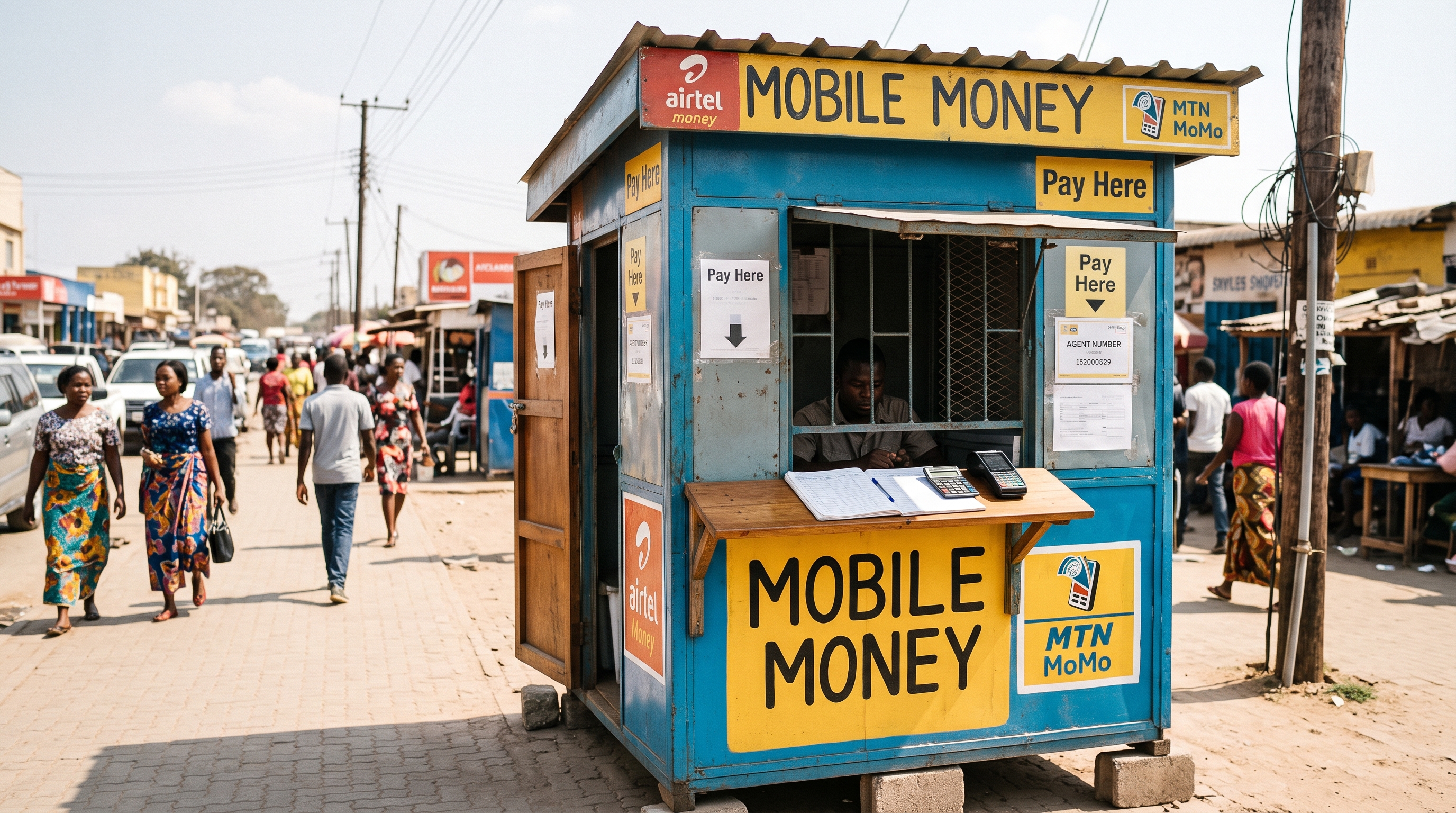
Mobile-money agents are the one candidate facilitator group with a non-programme payer already in place. They earn commission from a commercial principal for an adjacent service, they are trusted with other people's money daily, they operate inside the market, and they already occupy the position in the social structure the hypothesis describes. The B2 arm therefore tests sustainability directly rather than inferring it: the stipend is tapered to zero while B1's is held constant, and we observe whether the role survives the withdrawal of programme money.
The two strands also differ in the kind of trust they carry. The secretary carries associational trust: shared membership, social obligation, no money changing hands. The agent carries commercial trust: I hand you cash and you do not steal it, repeated daily, with no fellowship in it. Which kind transfers to an AI tool is open, and the answer tells a deployment whom to recruit.
Three risks are handled in advance. An agent's income depends on transaction volume, so the B2 tool build is identical to B1 and any transaction-linked prompting is out of scope. Agent-mediated fraud is a live phenomenon in mobile-money markets, so the scam-awareness orientation names this risk specifically. And agents are not cooperative members, so the strand needs its own recruitment route, with a go/no-go gate early in inception.
What Arm A actually is
Arm A is not "no intermediary", and describing it that way would misstate the finding. Existing trusted leads in Arm A clusters remain in place and will plausibly help members informally and unpaid. What Arm A lacks is a supported intermediary: no training, no stipend, no materials, no supervision, no escalation path. The contrast the study prices is therefore between an informally supported and a formally supported intermediary layer, which is the contrast that matters for financing, because only the second costs a programme money. We measure the informal layer rather than assuming it away: participants are asked who helped them, how often, and whether that person was paid. Where informal help proves substantial it is reported as an in-kind cost of adoption borne by the community, not as a zero.
What is measured
Four results are the study's verified outcomes, selected for attribution strength within the observation window. They are also a prototype of what a government could contract against at scale, once the study has established that they survive verification and at what rate they are achieved.
- Sustained use: at least one task-completing session per week for twelve consecutive weeks following onboarding. Verified by on-device telemetry and an independent audit sample.
- Independent adoption: sustained use in which every session in the twelve-week window is unassisted. Verified by triangulating three imperfect sources, session-level telemetry, participant self-report and direct observation on an audit sample, with the reconciliation rule fixed in advance. The facilitator's own log is not a verification source for this result.
- Improvement in record-keeping: complete and internally consistent sales and expense records maintained for three consecutive months, measured as change from the participant's own baseline. Reviewed for completeness, internal consistency, and usability by a blinded independent loan officer asked whether the record would support a credit decision.
- Facilitator retention: the facilitator active and earning documented income from the role at 90 days, retained at 180, and in the tapered arm measured again at each taper step and after the stipend is withdrawn. Not self-certified.

Revenue change, credit access, enterprise survival and household resilience are tracked against the trend panel and reported as association, because attribution is too weak over this window. All results are reported disaggregated by sex, with heterogeneity of adoption and cost by sex pre-specified rather than examined afterwards.
Two safeguards
Outcome measurement inside a trial creates two well-known distortions. We design them out rather than argue they are small. First, no payment to any party is contingent on data supplied by that party; facilitator stipends are paid for a fixed engagement period on community validation and independent audit, and are explicitly not contingent on how independent their participants become, otherwise the role is paid to maintain the dependence the study exists to end. Second, no payment to any party turns on the result: the delivery partners have no financial interest in which arm performs better, the evaluator is contracted independently of them, and the analysis plan is pre-registered before enrolment opens.
Conditions before any result counts
- Digital and AI safety: Users complete scam-awareness and basic AI-literacy orientation before adoption counts. The orientation names agent-mediated and intermediary-mediated fraud specifically.
- Informed consent and data protection: Documented, revocable, granular consent; data held on-device where possible; anonymised for programme reporting; no sharing with financial-sector parties without explicit permission. The tool logs events, never content or audio; raw events are reduced on-device to weekly counters before anything is transmitted; connectivity is never required to use the tool; and revoking consent does not degrade it.
- End-user co-design: No use case enters deployment before documented co-design sessions with the target population, with user sign-off at design milestones, and co-design groups that reflect the gender composition of the enumerated trader population.
- Independent verification: An evaluator appointed, and the verification protocol agreed and pre-registered, before deployment begins.
Success, partial success and failure thresholds, expressed as independent-use rate, as unassisted weeks and as cost per independent adopter, are set with the evaluator and fixed before enrolment opens. We commit in advance to publishing the results regardless of impact. A credible null on adoption economics is worth more to the field than another successful pilot narrative.
5. The cost numbers this produces
These are different quantities, and conflating them is the most common error in this kind of work.
All steady-state figures are reported by commodity segment as well as in aggregate, together with the cost drivers required to transfer the estimate to other settings. Device cost does not appear in the steady-state figures because devices are not provided. What is reported alongside them is the device-eligibility rate: the share of the enumerated trader population whose existing handset meets the performance floor. In a deployment that does not buy hardware, that rate, not the device price, is what determines reachable coverage.
6. What scaling would look like
An experiment that does not describe its own scaling pathway is a pilot. So we set out now what scaling would look like for whichever theory wins.
AI adoption and diffusion matter for economic development, but it is largely a private good in both its development and its use. The public sector is a critical enabler, and the two must work together for a viable scaling pathway to exist. Government will also likely have to be the funder of first resort, given how scarce funding is for innovation and start-up costs in this market; entrepreneurs building for informal-economy users generally cannot raise it commercially. But government has limited resources, every kwacha carries an opportunity cost, and public money must create value at every point in the value chain.
Two conditions follow, and we propose them as the shape of the scaling relationship.
- Alignment: Government should finance solutions whose problems are ones government itself believes are critical to delivering services to its people. Not solutions in search of a mandate. In Zambia this means alignment with the sectoral priorities set out in the National AI Strategy and the institutions established to oversee it.
- Payment on delivery, not on inputs: Government should pay on delivery of agreed results, not on the entrepreneur's inputs. Paying for activity, workshops delivered, users registered, devices distributed, produces pilots that report success and change nothing. Paying only for results defined in advance, measurable and independently verifiable, transfers delivery risk to the party that can manage it and gives the state a unit price it can budget against.
That is what this experiment is designed to produce: result definitions that survive verification, an evidence-based rate at which they are achieved, and a defensible cost per independent adopter. Those three things are what a results-based contract between a government and an entrepreneur needs in order to exist at all. Without them the state cannot price the contract and the entrepreneur cannot accept the risk.
7. What transfers
The output is not a tool. It is a number and a method that transfer.
- Steady-state cost per independent adopter, with and without an intermediary, and the difference between them, which is the price of the intermediary layer. Usable by any programme financing AI deployment to low-income users, in any sector.
- A validated method for measuring adoption: telemetry-instrumented, independently auditable, with a defensible and arm-neutral operational definition of independent use, which the field currently lacks.
- An answer on the intermediary layer: whether trusted human facilitators are a transitional cost of adoption or a standing one, and which kind of trusted person carries the tool best.
- A test of whether the layer can pay for itself: what share of commission-earning facilitators keep the role as programme money is withdrawn, and what residual public subsidy, if any, the layer still requires. This is the figure that determines whether a ministry can budget for adoption at all.
- A device-eligibility rate for the target population: what share of an informal trading population can be reached by an on-device tool without buying hardware.
This is complementary to, not competitive with, work already financed. Language and model public goods are being built; national scaling containers are being established. Neither answers what it costs to move one worker from onboarded to sustained independent use. A hub choosing which solutions to scale, and a ministry deciding what to budget for, both need that number.
8. What this cannot settle
- Whether independent adoption produces any durable economic change. Eighteen months of measurement against a between-market comparison will not settle it, and we do not claim it will.
- Whether a result from Lusaka market traders transfers to rural, agricultural or non-trading informal populations. We can report the cost drivers that would govern transfer; we cannot demonstrate transfer.
- Whether the finding survives a model generation. A result about human intermediation obtained in 2027 may be partly a result about how good the model was in 2027.
- Whether a facilitator role that survives six months without subsidy survives three years. The taper observes survival immediately after withdrawal, which is the strongest evidence available in this window but is not durability.
- Whether cooperative-organised traders are so unrepresentative of the informal economy that the cost figure misleads a ministry planning universal coverage. We flag it as a lower bound; we cannot correct it from within this design.
9. Where this stands, and what we are asking of readers
The experiment is being designed with partners in Zambia and will be named in full when it is funded and the protocol is pre-registered. What we ask of readers now is criticism. Is steady-state cost per independent adopter the right primary question, or is there a more binding one? Is a three-arm design the cleanest way to isolate and price the intermediary layer, and is the tapered agent strand the right way to test whether anyone but a donor will pay for it? Is a single treatment market with a separate comparison market the right trade between contamination and cost? And does work already exist that answers any of this? If it does, we should not run it.
Kato Steven Mubiru
Co-Founder and Chief Executive Officer, Crane AI Labs
Idah Pswarayi-Riddihough
Founder, Flame Lilly Global
Sources
Otis, N. G., Clarke, R., Delecourt, S., Holtz, D. and Koning, R., "The Uneven Impact of Generative AI on Entrepreneurial Performance: Evidence from a Field Experiment in Kenya", Harvard Business School Working Paper 24-042.
Singh, N. and colleagues, "Farmer.Chat: Scaling AI-Powered Agricultural Services for Smallholder Farmers", Digital Green and Microsoft Research; and Digital Green's published account of deploying through extension agents rather than direct to farmers.
OECD.AI Policy Observatory and the Zambian Ministry of Technology and Science, on the National Artificial Intelligence Strategy of Zambia, the National AI Council, and the role of the Smart Zambia Institute.
Mwango, M., Kaliba, M., Chirwa, M. and colleagues, "Informal food markets in Zambia: perspectives from vendors, consumers and policymakers in Lusaka and Kitwe", International Institute for Environment and Development discussion paper.
Zambia Statistics Agency, Labour Force Survey, for informal-sector employment shares.
Rogers, E. M., Diffusion of Innovations; Glasgow, R. E., Vogt, T. M. and Boles, S. M., the RE-AIM framework; Proctor, E. and colleagues, on implementation outcomes; May, C. and Finch, T., Normalisation Process Theory.
Uganda Cultural Context Benchmark, Crane AI Labs, in Inspect Evals.
